


Showing posts with label Change. Show all posts
Showing posts with label Change. Show all posts
Thursday, 25 February 2016

Friday, 19 February 2016
Thursday, 18 February 2016
As Forces Collide, IT Disruption (and Content) Will Soar
Forces are colliding to make 2016 an interesting year for those trying to manage information with technology that touches end users. The traditional IT role, as we know it, is undergoing disruption. As I survey the macro trends impacting Enterprise Content Management (ECM) and cloud, I am ready to bet that radical change will be the IT norm next year and in the foreseeable future. Based on my years in enterprise IT and my on-going customer interactions, I thought I’d share my own thoughts about the coming year ahead and the sea of change that will be fast upon us, at least the way I see it.
 Management (ECM) and cloud, I am ready to bet that radical change will be the IT norm next year and in the foreseeable future. Based on my years in enterprise IT and my on-going customer interactions, I thought I’d share my own thoughts about the coming year ahead and the sea of change that will be fast upon us, at least the way I see it.
My first prediction?
Power to the People
We are experiencing a major shift in who has control over application choice, and that control will readily land with end users, placing the heaviest pressure yet on internal IT departments. We are seeing a rapid wave of change that won’t stop anytime soon, arming end users with even more choices in tools they can procure—and procure them they will.
With the advent of IoT and exponential growth of practically everything internet-related, end users are becoming more and more empowered. They curate their own content, self-publish in multiple content formats including unstructured data (e.g. images and videos), and consume from their device of choice (or multiple devices simultaneously).
 Shadow IT already has savvy end users self-selecting the IT tools and apps they want, even in the workplace. Further abandonment of sanctioned in-house tools will leave IT seriously rethinking how to change their ways and live up to the new user expectations.
In the ECM space, success will be measured by how many end users are productive and empowered, not by “go-live” milestones. The need for content management will continue to soar, just like content volume itself and the number of individuals creating it.
Software in Slivers
This leads to my second prediction – a shift in how software is designed, both to speed up functionality to these empowered end users, and to provide more technical flexibility. Business requirements from technology will continue to ebb and tide as companies keep up with the rapidly changing dynamics and stay one step ahead. Agility and flexibility will be pushed ahead of other requirements.
These business demands will force IT to rethink their standards on application development and how they leverage software to deliver specific solutions for groups of users. A “Lego” approach will become that standard, allowing for even more rapid development on top of existing software development frameworks currently in place. The list of approaches is also growing — agile, waterfall, iterative, scrum, etc.. Slivers of software functionality, widget-like, coupled with discrete services will be snapped together to deliver specific solutions for groups of users.
 These purpose-built blocks in the ECM world will deliver individual capabilities, such as “capture” or “esignatures”. Snapped together, these blocks will quickly deliver a full, rich solution like claims processing, for example. Less and less will vendors design monolithic code sets packed with comprehensive functionality, but instead offer a plethora of blocks that IT organizations can pick and choose from, resulting in a well-tailored solution.
The open source movement originally ushered in the building block model for software development. Moving forward, more of the industry will turn to the speed and nimbleness that these use case-driven development models can offer. It won’t be overnight – there is too much investment in existing IT infrastructure. But just as the IT role will look vastly different in the future, so too will the software IT needs to service end users.
Hybrid Cloud Front and Center
What will happen quickly and take off is the shift to cloud, and more specifically, hybrid cloud in the ECM space. That’s my third and last prediction (at least for this blog!).
IDC already predicts that half of IT spend will go to cloud infrastructure and cloud-based solutions in just a few years. The appeal of hybrid will fill the mix and match approach many businesses need. For example, highly regulated industries may place certain functionality in a private cloud on premise, while other functionalities sourced from a public cloud, and still, other functionalities may continue to reside in traditional on premise environments.
 In my experience, every customer has a unique situation, set of users, and specific use case. There is no right or wrong cloud answer — they need cloud options to suit their IT requirements placed on them by quick changing business demands. Hybrid cloud will deliver the flexibility to create environments that fit and meet their needs. Companies will master their cloud formulas and hybrid cloud will become front and center.
It’s obvious the IT world has started to change dramatically. More upheaval is still yet to come, but those who foresee the shift will move quickly to develop new skills and innovate, to deliver to new demands.
Saturday, 13 February 2016
How to Orchestrate BPM Change
One of the continuing issues that must be resolved to deliver an ability to effectively leverage BPM and BPMS-enabled BPM is related to formal governance. Today, BPM is being used for larger and larger projects and BPMS supported BPM is taking on greater challenges. Many projects are beginning to look at work at a complete process level and recognize that most processes involve work in multiple business units.
This recognition is moving solution development beyond the traditional boundaries of IT/client involvement and opening it to a required collaboration between multiple groups. Likewise, the move to consider customer experience in solutions is adding an extra dimension of design and solution construction to many efforts. Then there is the growing need in many industries to deal with compliance. All of which is increasing complexity, involvement, and a need for controlled collaboration.
This type of control is fairly new and requires an ability to orchestrate the involvement of the multiple groups that are involved in the creation and deployment of any improvement that includes application support – in other words, almost every solution. This orchestration includes leveraging the functions supported in licensed application products, such as ERPs, integrated insurance packages, or in the case of healthcare, large Health Information Systems. However, it must be remembered that while these packaged products will help save time and cost, they do not provide a competitive advantage and are important mainly because they can reduce common operational tasks in business workflow.
The BPM CoE should thus be positioned in a company to focus on improving competitive capabilities, with revenue enhancement potential/the customer taking center stage in any new design. Once these goals are met in the design, the designs should then be analyzed for cost reduction opportunities. To control this changing design focus and the involvement of people from multiple business areas and differing ideas on how change should be approached, the BPM CoE will itself need to evolve and develop an ability to do things they may not offer today. The BPM CoE will thus need to identify both current and needed capabilities and then evaluate their level of competency in each of these areas.
The CoE’s managers will need the ability to build collaborative groups with membership as needed and then leverage methodologies and standards to control everyone’s involvement. This has a significant impact on the role of BPM and the CoE in the company. It also has a significant impact on the type of solutions that are delivered.
However, given that every company is at a different place in this capability evolution and maturity, it is necessary to start any move to expand the types and levels of service offered by defining the vision that management has for the way BPM will be used. This will give you a target to use in determining how the BPM CoE should evolve and increase its value to the company.
Friday, 12 February 2016
How to Build a Collaborative Culture

There are plenty of enterprise collaboration tools to get work done better and faster. But are we optimizing the use of those tools to make collaboration the best it can possibly be?
“A little bit of culture change can go a very long way — and you don't have to tackle the entire organizational culture or its myriad of potential sub-cultures,” Jed Cawthorne told us this month. “You should not shy away from small, incremental changes that can potentially make a big difference.”
So what should you do?
The Question
How do you build a collaborative workplace culture?
The Answers
Michael Fitzpatrick, CEO, ConnectSolutions

Fitzpatrick is CEO and founder of ConnectSolutions, a private-cloud solutions provider for Microsoft Skype for Business and Adobe Connect. With more than 13 years of experience in software and technology development, Fitzpatrick has built a track record in enterprise and government solutions. Tweet to Michael Fitzpatrick.
At CoSo, we believe high-quality experiences with collaboration, communication and learning solutions can dramatically improve the worker’s ability to support the goals of the organization.
But a truly collaborative culture can’t be achieved without carefully tuning your technology, people and processes so that they’re in perfect alignment with each other.
You can tell your people to work together, but you can’t create a truly collaborative workplace culture if you don’t provide them with the tools they need to work together — especially with the growing reliance on dispersed workforces and teleworking.
For a time, this was a tough task as the enterprise was flooded with personal tech that served the user’s needs but tended to fragment collaboration within the team at large. But unified communications has since evolved from the deployment of disparate tools to platforms designed to serve all in a seamless and standardized way.
Now, we can support more collaborative work environments by embedding UC into the organization’s business process workflows, creating frictionless communication that threads email, instant messaging, voice over internet protocol and video collaboration through the very apps and documents that people work with every day.
The work environment becomes more flexible.
Collaboration for workers becomes, once again, a human task that isn't disrupted by the very technology that's supposed to enable it.
Of course, the workforce must also be primed to support collaboration in the enterprise. This means ensuring everyone from on-site workers to mobile teams and freelancers is participating and that the desired collaborative behavior is being exemplified at the C-level.
It means working with HR to create best practices, prioritizing cooperation in the hiring process and creating clearly defined roles. Once your technology, people and process are in sync, a truly collaborative environment will take hold.
Sameer Patel, GM and SVP, SAP
 Patel is GM and senior vice president of product management and go-to-market at SAP Cloud/SuccessFactors. Before SAP, he lead enterprise technology teams in the consulting and systems integrator business, where he focused on designing and executing customer, employee and partner networks and associated applications. Customers have included Intel, Nike, CA, Oracle, Sun Microsystems, XO Communications, Symex, McKesson, Wrigley and others.Tweet to Sameer Patel.
You start by throwing out all the nebulous metrics such as sharing and productivity that don’t matter to most executives or aren’t easily measurable by employees.
What does matter to executives and most employees is executing their individual and team mission and charter. And if you can channel the benefits of collaboration to executing those objectives better and faster, the basis for a collaborative culture emerges in a much more organic and natural way.
To start, identify two to three functional areas where the cost of not collaborating on a given business activity is terribly obvious.
Examples are selling or supporting customers, on-boarding new employees, developing product or coordinating hundreds of vendors across your supply chain. Such tasks have established key performance indicators that everyone is already swimming toward and innately require collective output.
It becomes readily apparent to everyone that a collaborative culture around tangible functional processes can be an indispensible enabler to meeting core performance goals.
Deidre Paknad, CEO, Workboard

Paknad shapes Workboard’s product strategy, customer engagement model and thought leadership efforts. She said she is passionate about providing tools and insights that help leaders engage their teams in great achievement. At IBM, she was vice president of a global business and worked to improve information economics for enterprise customers. She has been recognized by the Smithsonian for innovation twice and has more than a dozen patents. Tweet to Deidre Paknad.
How team leaders and executives listen and engage has a huge impact. People hear what we say and may miss what we mean, so leaders’ words invite or crush engagement.
Start with "yes" to get ideas and information to flow. Show people you’re open to their ideas, facts and input. You shut things down when your first answer is no — “no, we can’t do that” or “no, we don’t have the budget.”
While there are instances where there is no budget, the instant “no” can be more habit than fact. When people anticipate a “no”, they avoid bringing forward information or ideas altogether. As Tina Fey says, “start with yes and see where that takes you.”
Secondly, assume AND rather than OR to improve collaborative decisions. Sometimes in conversations people assume each new idea supersedes or displaces those expressed before it — my idea or yours, one option or the other when in fact it’s my idea and yours, one option and another.
Without realizing it, we pit ideas against each other and shut down consideration of additive ideas. This wastes time on false debates. Growth requires more than one idea, market segment, revenue source, and initiative so the false competition undermines collaboration, culture and profit.
Finally, Ask "why" to signal and ensure you heard. It signals authentic engagement and provides people with an opportunity to share logic so you genuinely understand. It also gives you pause to consider the idea’s merits before moving on, to frame your “yes and” response, add another “why” or provide a well-considered “no.”
In the grand scheme of things, it doesn’t take more management time to be an authentic listener than it does to resolve false debates, dig for facts that people don’t want to share or recover from decisions that were ill informed.
Guy Nirpaz, CEO, Totango

Nirpaz is the CEO and co-founder at Totango, a customer success and user engagement management platform. Before starting Totango, he focused on real time big data as EVP of engineering at GigaSpaces and was chief architect at Mercury. Nirpaz said he's driven by the possibilities technology offers to improve the way people do business. Tweet to Guy Nirpaz.
Culture is about people, motivations, successes and frustrations. The first rule of collaborative culture is making sure the company acts as a team and that the mission and goals are all collaborative. We succeed and fail together as a team.
It starts with hiring people that are not only excellent at what they do, but people that are comfortable to work as a team. Sometimes very talented people are not hired due to massive ego.
A good smelling sign to recognize it is when they are being asked about their previous company, you get the sense that they were the stars while everyone else was completely useless.
The second part is to foster collaboration. This is first and foremost the role of the executive team. As a start the executive team needs to demonstrate characteristics of collaboration. You know that you're not there when fingers are started to be pointed out when stakes are high.
Beyond that the executive team should continuously figure out ways to communicate the joint goals, and actively take part at conflict resolution by always pointing out the joint goals and missions and how those should be interpreted in this case.
Anthony Smith, CEO, Insightly

Smith is CEO of Insightly, a San Francisco-based SaaS CRM application. Before Insightly, he was a consultant for IBM and a software engineer for global-mining consultancy Snowden. Tweet to Anthony Smith.
Building a collaborative culture starts with identifying your company’s core values, like clear and frequent communication, and then establishing those right off the bat. At Insightly, we want our employees to have a healthy balance between work and their personal lives so we offer flexible hours and work locations.
Everyone still works at least 40 hours a week, but many employees are remote or choose hours outside the typical working day. One big challenge that comes with implementing a remote-workforce program is making sure that employees are collaborating just as much as they would if they sat next to each other.
To maintain constant communication and collaboration between team members, provide remote employees with extra services that help to ensure that they are clued in on everything that’s going on in the company.
Beyond the day-to-day tasks, fly in remote employees every quarter to encourage team bonding. And when we first hire a new employee, we have them spend a week at company headquarters so they can become acquainted with co-workers, attend in-person training meetings and familiarize themselves with business processes. This helps to ease them in and move them toward the end goal of becoming completely ingrained in the team.
Title image by Asa Aarons Smith/all rights reserved.
Businesses struggling to transition to digital era
Most businesses are failing to grasp the opportunities of digital business models, according to Christoph Kilger, partner at Ernst & Young, Germany.
“Concerns around IT security are holding them back and many are still locked in a traditional, conservative way of thinking,” he told journalists in Stuttgart.
Kilger said another key challenge to making the transformation to the digital era is that businesses are struggling to understand new technologies such as machine-to-machine communication and machine learning, and the exponential process improvements they can enable.
Ernst & Young believes that smart, connected products are core to enabling new services and business models that will drive a market Cisco estimates will be worth $14.4tn a year by 2022.
“The value will come from being able to do entirely new things with new technologies. We are entering an era in which many technologies will combine to bring about something new,” said Kilger.
However, he pointed out that in some cases value will be created in one place and taken away in another, as has already happened with WhatsApp.
“WhatsApp was able to amass more than 400 million users in four years and will soon reach a billion, but an estimated £350bn has been lost in text message revenue as a result,” said Kilger.
Similarly Blockbuster has been replaced by Netflix, which is able to capitalise on its unparalleled understanding of viewing patterns.
“The replacement of businesses is being driven mainly by new technologies, and the result is a dramatic change in the composition of businesses,” said Kilger.
Ernst & Young predicts that new technologies will enable greater horizontal and vertical integration in businesses and business functions.
However, this is difficult for established businesses to adopt, which has led some to start working with startups to enable digital transformation.
“Startups and established corporations can leverage individual strengths and explore acceleration opportunities through collaboration. In the past, IT has been an enabler of business, but in the future IT will be part of business” said Kilger.
Ernst & Young predicts that all businesses will soon need chief digital officers to explain what it means to become a truly digital enterprise.
“IT will have to manage the whole technology stack, including software, connectivity layer, cloud, apps in the cloud and technologies enabling the internet of things [IoT],” said Kilger.
This, in turn, will create the need for companies to have access to data scientists to enable them to understand and benefit from all the data they are generating and collecting.
Bill Gates once said: “We always overestimate the change that will occur in the next two years and underestimate the change that will occur in the next 10. Don’t let yourself be lulled into inaction.”
“The next 10 years will be important in terms of digital transformation. We will see a completely different world by then,” said Kilger.
Tuesday, 9 February 2016
5 factors to help company growth

- Dynamism
You should not settle for a rigid business model. The speed of adaptation to change is critical to the success or failure of a company. Competition is increasing and how quickly companies adapt to changes in the business ecosystem will determine the success of their actions as a company.
The use of a BPM system with well defined Business Rules ensures that adaptations to changes are made almost instantly. A change in regulations could be a major headache for paperwork however with a BPMS, such changes are automated.

2. The Big Picture
All departments should work in unison, not solely focusing on their own work but seeing the bigger picture. The idea is to encourage participation among all members of the company to promote unification and achieve the end results. If everyone works with the same vision it will lead to greater productive development.

3. Technologization and technification
Technological integration is a common factor amongst startup companies. Indeed, the technological evolution is linked to our development and any company which chooses not to adopt new technologies will be left behind and will struggle to remain competitive.

4. Project confidence
It is vital to have a high level of confidence in the company, therefore projecting confidence, the momentum to achieve objectives, sincerity, respect for each and every person involved in the business and belief in their own projects are essential factors in the day-to-day running of every company.

5. Perseverance
Objectives are not always met, but we shouldn’t get disheartened. Indeed, we often learn valuable lessons from failure. Failing should be seen as good training and we should try again. It is all a question of reformulating ideas and insisting on the desired objective.
The adoption of intelligent analytic systems integrated in our business process management system can help us determine what went wrong and thus change these factors.
Business performance measurement builds a performance culture
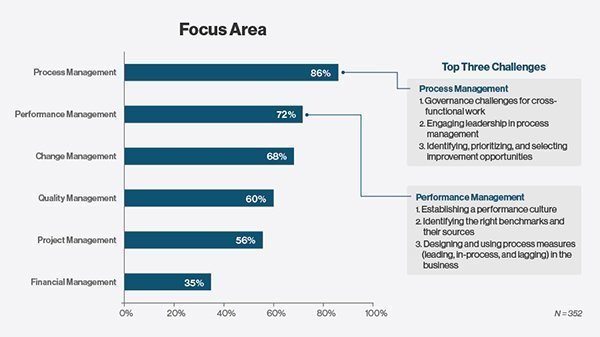
As 2014 came to a close, the American Productivity & Quality Center (APQC) conducted a short survey to better understand the pressing priorities and challenges of business excellence practitioners for 2015. We found that process and performance management were the top two areas that business excellence staff planned to focus on in 2015 (see Figure 1).
Although process and performance management are separate focus areas, process management is often a starting point for organizational performance improvements. For an organization to improve its performance, it first must understand how to get work done effectively. This can include using business performance measurement to assess how the organization performs work and identify the performance and value of each process, as well as pinpointing which areas are underperforming, valueless, redundant or inconsistent with definitions and execution. Hence, all these process concerns link back to performance improvement opportunities.
Practitioners are prioritizing a wide array of challenges tied to performance management, from overcoming governance hurdles (e.g., identifying ownership) to including lagging, in-process and leading measures. These challenges have two main concepts in common: engagement and measurement.
If done correctly, business performance measurement can be the lynchpin of effective engagement. Organizations often will start measurement by assessing the performance and value of its processes, engaging employees in process activities and providing clarity on who does what.
In other words, assessing an organization's current state helps provide a baseline for determining and prioritizing process improvement opportunities, identifying measures for performance management, and engaging employees to think in process terms. An organization can baseline its current state in several ways: benchmarking, surveys, workgroups and value stream assessments. The method applied depends on the amount of performance data available, business process maturity and the amount of employee engagement that is necessary.
Overall, when organizations ignore the effect of change initiatives on people, roadblocks arise and intended results fall short of expectations. Many organizations conduct limited workforce engagement for process and performance management. Limited engagement results in employees who do not understand, care about or even agree with the process. Employee engagement creates buy-in with employees and overcomes organizational resistance. Outlining the value of process management in terms meaningful to leadership results in the sponsorship and resources necessary to make process efforts effective.
The greatest challenge for business process management is making it part of the culture and getting employees passionate about it as well. Many organizations face resistance during process rollouts because they don't involve employees in the process. If organizations involve their employees in the current state assessment, they increase engagement because employees feel a sense of ownership in identifying what the key issues are and what measures matter. Including these measures as the value drivers in process and performance improvement business cases establishes the measurement efforts in terms that leadership can get behind.
For example, Elevations Credit Union established a strategic initiative to improve its organizational performance. Its first objective was to address its ad hoc, patchwork processes. Elevations' approach combined current state assessments, employee workshops, process management and tool training, and mapping contests to engage employees in process management and establish a performance culture.
However, Elevations' real breakthrough with leadership came when it started using a performance dashboard to track and monitor its process performance. As the organization's processes and measures grew in complexity and the leadership's need for data to support its decision making expanded, Elevations implemented an enterprise dashboard system that provided access to the organization's key performance indicators (KPIs -- actual, target and variance). A corresponding "drill down" dashboard for each category of the enterprise process map allows leadership to root cause any variations in performance.
According to Elevations, the ability to get real in-process metrics was a fundamental change in how it operated. From that moment on, Elevations' senior leaders bought in on process management and began managing via enterprise dashboards. All of its metrics link back to processes, so it can now figure out what's broken and why by tracing back to the source of the problem.
Elevations' success using performance dashboards comes as no surprise. When discussing performance measurement, most practitioners refer to the type of measurement that helps companies monitor its current and past states. Thresholds, both low and high, for KPIs are set and managed by exception. When data begins to move outside the threshold limits, the performance measurement system can alert management, who then attempt to diagnose the problem and address its causes. Practitioners refer to this type of measurement as diagnostic control systems. Although this type of measurement provides management with "auto-pilot" capability that can keep the organization on target with its goals, it is frequently insufficient for success.
The performance management challenge -- designing and using process measures in the business -- is one reason this approach is not always successful. Most dashboards look at in-process and lagging indicators while overlooking leading indicators that help organizations proactively react to changes in the business environment.
Several methods are available for including leading indicators in an organization's performance management. The most widely known is the balanced score card. Normally (although not required), the balanced scorecard is broken down into four sections called perspectives:
- Financial -- strategy for growth, profitability and risk (typically the shareholders perspective). The scorecard considers financial measures lagging indicators and includes looking at growth, profitability and shareholder value.
- Customer -- strategy for creating value and differentiation (customers' perspective). The customer measures are often leading indicators and include customer satisfaction, net promoter score, brand awareness and market share.
- Internal business (operations) -- is the strategic priorities for business processes. Operations measures are usually in-progress, performance-based measures used to indicate how well the business is running (e.g., cycle time, quality, employee skills and productivity).
- Learning and growth (people) -- the priorities to create a climate for change, innovation and growth within the organizations. This includes, but is not limited to, employee training, corporate culture, as well as individual and organizational improvement. The measures are typically in-progress or lagging measures that vary but can include employee behaviors and adoption rates.
The important takeaways here are that measurement plays an important part in how organizations can engage employees -- both leadership and frontline -- in process and performance management. By including the right blend of measures an organization can improve its decision making capabilities for improvement opportunities, provide transparency and ultimately establish a performance culture.
Monday, 8 February 2016
Wednesday, 3 February 2016
CAN CORPORATE CULTURE BOOST FINANCIAL PERFORMANCE
Executives spend a lot of time worrying about their companies’ products and prices, but they don’t spend nearly enough time worrying about corporate character.
A lot of them don’t believe companies even have a character, and others don’t see what difference it could possibly make.
Correlation between employee investment and performance
But is there a direct correlation between employee investment and performance? As Prof. James L. Heskett wrote in his latest book The Culture Cycle, effective culture can account for 20-30 percent of the differential in corporate performance when compared with “culturally unremarkable” competitors.
Organisational culture eats strategy for breakfast, lunch and dinner so don’t leave it unattended
Kotter and Heskett’s landmark study Corporate Culture and Performance documented results for 207 large U.S. companies in 22 different industries over an eleven-year period.
Kotter and Heskett reported that companies that managed their cultures well saw revenue increases of 682% versus 166% for the companies that did not manage their cultures well – stock price increases of 901% versus 74% – and net income increases of 756% versus 1%.
Corporate culture is an incredibly powerful factor
Corporate culture is an incredibly powerful factor in a company’s long-term success. No matter how good your strategy is, when it comes down to it, people always make the difference. As Peter Drucker so wisely stated, “Culture eats strategy for breakfast.”

Top 4 corporate culture infographics
Culture is eating what it kills – such as strategy, change management, innovation, operational efficiency, lean process and even including vision and mission.
How to cultivate organisational culture?
Corporate culture is a hard thing to get right. It’s a moving target that means something different to everyone.
It grows and evolves over time and is the result of action and reaction. It is the lingering effect of every interaction. How to cultivate organisational culture?
Monday, 1 February 2016
Eight steps to making your business transformation stick
There isn’t a day that goes by when you don’t read about the need to change, transform or re-invent your business, your life or your world.
“The only thing that is constant is change” – Heraclitus
Organisations are under increasing pressure from outside influences, such as international competition, disruptive technologies and new legislation – to name a few. For many organisations, transformation is no longer optional, it is imperative.
Change is challenging and often quite daunting. How do we ensure that we are not one of the 70% of transformation projects that fail? (Ref McKinsey)
TURN TRANSFORMATION INTO AN ADVANTAGE
At this point, I should put my cards on the table and in a group therapy session style confirm:
“I am Chris and I work for a software company”.
I wanted to share how we believe you can really make transforming your business stick, and deliver ROI at each step.
Step One – Organisational Review
Workshop what makes your business unique and identify what makes you better than your competition – understand how these differences translate to operational strategy.
Step Two – Process Review
How do you do what you do? Understand the processes that deliver your business outcomes. Everything you do is a process, so what makes your processes unique? Who, what and how do you deliver them.
Step Three – The Company DNA
Document what you have learned in previous steps to create a “Company DNA”. Use this as a starting point to deliver meaningful, and more importantly, measurable change within your business.
Step Four – Collaborate
Make the “Company DNA” available to your whole organisation and allow your people to review, collaborate and improve on your business processes. Task departments to take responsibility for process improvement and make it part of what you do too.
Step Five – Change Strategy
Identify areas or processes that are candidates for change and/or automation. Do this based on an agreed set of ROI measures, this makes decisions measurable, more impactful and increases the buy-in from people. Ensure your strategy is communicated across the enterprise and highlight successes as they happen.
Step Six – Prototype Automation
In areas where automation is required, choose the fastest to implement with the highest return on investment. Prototype platforms in a RAPID way based on the process outcomes in the steps 4 and 5.
Step Seven – Go Live
Rollout platforms and processes into your organisation that have delivered the expected results and ROI during the prototype phase. Deliver user training using the outcomes in previous steps, and set KPIs for each process to continually monitor and review.
Step Eight – Accelerate Change
Use this method to adapt to changes in market, competition, legislation or any other disruptive influences that happen in the future. Evaluate regularly.
CHANGE IS INEVITABLE AND CHANGE IS CONSTANT
In a world where change is the only constant, organisations with the fastest learning curve thrive.
Businesses today must learn to embrace change. Successful businesses will use change to their advantage. Intelligent businesses will enjoy the journey.
I will leave you with a very telling statistic to ponder:
Gartner predicts that by 2017, 20% of all market leaders will lose their number one position to a company founded after the year 2000 because of lack of digital advantage.
SOURCE: FlowCentric
Subscribe to:
Posts (Atom)


