Pages

Showing posts with label Procedure. Show all posts

Monday, 18 January 2016

RUN YOUR BUSINESS MORE EFFECTIVELY WITH BUSINESS PROCESS MANAGEMENT

Businesses and companies essentially include various techniques and procedures. These systems are essential for the company to operate effectively. However, when there a great deal of systems set up the capacity for them to deal with each other can be affected by inadequacy.
00ac3ad
There are many ways to correct this, and this might be attained internally through the business alone. It might however be accomplished on the surface by a consultancy firm who’re specialized in supplying an assessment or a summary of the entire business design, and then suggest parts of improvement and supply sensible solutions to these locations.
It’s not only about benefitting the company, it is also about benefitting clients or people of a company. Improved client satisfaction is a by-product of business process management, and there’s also a rise in item quality to be acquired from BPM. It is beneficial for both company and the customer. Shipping speed plus time-to-market rate is also enhanced through the setup of BPM.
The business process management system is a straightforward procedure that can figure out the process required to be used to fulfill a customer’s need. It is a system that provides a company a chance to develop and boost themselves to satisfy the necessary goals. This is 1 attribute that can offer you an advantage over your competitors. It is among the wonderful way of managing a business. It is vital that the procedure and the corporation’s quest, perspective and aim are interrelated because it enables you to realize that the process is flawlessly arranged with what business essentially wants to do.
Business procedure, main concepts or perhaps the rules never ever change, precisely what changes are the methods which are used. For instance: In past a model or a typewriter might have only made items faster, however the perception and the model might have remained the identical and thus it is essential to improvise the equipment to make the working of the organization easy and simple. Most businesses all the processes and procedures have to be handled in a certain manner every single person, whether it is on the minimum level or the maximum level plays a role in business management functions.
The business process management is a familiar strategy of the demands, desires and needs of the customers. It’s an approach that increases the business by advancement and technology. The company today has arrived at new model and thus they require new technologies and adapted to incorporate the system over all sorts of obstacles. With all the equipment accessible one can take his company to the best level.

Friday, 30 October 2015

The Winning Formula to a Successful Change Team

I’ve been asked by many of my clients: "What’s the best way to pull a successful change team together?" Now, there are many views on this out there but I like to keep it simple! As Bruce Lee once said: "simplicity is genius". 
 
Firstly, you need to look at the type of person you want to entrust with improving your organization – Attitude is everything! A positive, can-do attitude wins every time for me over any number of MBA qualifications, so let’s take a look at teams…
 
There are lots of definitions as to what makes a team. One of the better definitions states:“… a team is a group of people who co-operate and work together to achieve a goal in a way which allows them to accomplish more than individuals working alone could have achieved.”
 
Ideally, they will all be working together towards commonly understood, shared and achievable objectives.

Obviously, when a new team is formed, it is very rare that it will perform effectively from the start. There is a development process that each successful team must go through. This development process has three distinct stages:
  • Chaotic
  • Formal
  • Mature
 

Chaotic Stage

 
The chaotic stage is the very first stage that a new team goes through. As the name suggests, a team in the chaotic stage of development will exhibit typical characteristics. These include:
  • Inadequate planning
  • Not enough time given to setting clear, agreed objectives
  • Making too many assumptions, particularly about objectives, targets and team roles
  • Underestimating problems
  • No clear procedures, agreed ways of working or development of understanding
  • Poor communication within the team (during discussions, some team members will dominate while others will not be able to get their ideas heard)
  • Everyone tending to talk at once (this, coupled with poor listening skills, will lead to ideas that are lost)
  • Leadership is either non-existent, unclear, too heavy-handed or not accepted by the rest of the team
 
It is easy to see that teams in the chaotic stage will fail more often than they succeed. However, these failures will be ‘explained away’ and ‘glossed over’ instead of being analyzed objectively.
 
Chaotic teams will be fun for a while. Team members will tend to overcome uncertainty by diving headlong into the task without really giving thought as to what they are doing or how they are working together.
 
Eventually though, the team will begin to react against the chaotic stage by becoming more formal in its approach. There is a danger however, that the team will overreact and introduce formal procedures that are too rigid and restraining.

The Different Stages of your Change Team
 
Now we’ve looked at the early stages of forming a team, lets discuss the ‘formal’ and ‘mature’ stages:
 

Formal Stage

 
The formal stage is likely to be more successful, but this success will be limited by inflexibility. The team at this stage of its development tends to be too regimental and fails to utilize the full capability of all its members. This is due largely to over-rigidly defined roles within the team. Probably the worst case of this being that far too much dependence is placed on the leader to co-ordinate, plan, and make decisions as well as to control.
 
Typical characteristics of formal teams include:
  • Strong likelihood of overreacting - becoming too formal in procedures and roles
  • Strong leadership often seems the answer to problems of the chaotic stage - the leader is often criticized for failure to be strong enough during chaotic stage
  • Formal/specific roles (timekeeper/secretary etc.)
  • Poor flexibility
  • Not making use of capabilities of members
 

Mature Stage

 
Gradually, the team begins to develop out of the formal stage and starts to take ‘liberties’ with its own procedures without slipping back into chaos. This progress to maturity is not guaranteed however.
 
If the team rebels against the rigidities of the formal stage too early, it can easily slip back to the chaotic stage.
 
On the other hand, some teams get stuck in the formal stage and never quite reach the mutual understanding and trust needed to move to maturity.
 
The breakthrough to the mature stage usually occurs when the team realizes that some parts of their formal procedures are of no use to the particular task they are doing. The team cuts corners and finds it can cope.
 
Typical characteristics of mature teams include:
  • Procedures for objective setting, planning, discussions etc. that are agreed and based on the task or situation
  • Procedures that are flexible rather than rigid
  • Team roles that are more relaxed, with members contributing on the basis of what they can offer in a specific situation, not according to rigidly defined responsibilities
  • Communication that is good within the team. (ideas and suggestions are given freely and are listened to and built on)
  • Leadership style is more ‘involving and participative’ as the situation dictates
 
The team in its mature stage of development is likely to be very effective.

Getting your team to continue to perform
 
One of my recent posts I discussed what makes a successful change team, so, you've formed a team and you know they will go through the stages of chaotic, formal to mature but how can you get them there and ensure they continue to perform at a stellar level?
 

Team Reviews

 
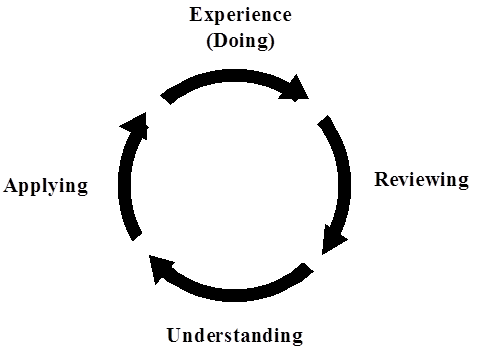
To move from the chaotic stage to the mature stage, the team must build on its experiences. It is commonly believed that you learn from experience. Actually, you gain understanding from reviewing and thinking about your experiences. You can then draw appropriate conclusions and plan to modify your behavior in the future.
 
You learn by doing and understand by reviewing
 

The Learning Cycle

 
There is a procedure for conducting a team review. It is a skill that should be learned and practiced.

Procedure

 
Start by analyzing your team results:
  • Did you achieve the task?
  • What aspects of the task did you do well?
  • What aspects of the task did you not complete satisfactorily?
  • Did individual roles, contributions, activities and attitudes benefit the team?
 
REMEMBER, your analysis should be factual and honest.
 
Analyze why you performed the way you did. You need to shift the focus of the review from ‘ what happened’ to ‘WHY it happened!’ Your analysis should cover both task and process-related aspects - how your team approached the task; how you as team members worked together.
 
Having focused on the causes you can now identify what strengths you can maintain and develop and what weaknesses you need to overcome. Again, this should include both process and task-related aspects of your performance.
 
It is important at this stage that you adopt the ‘Pareto Principle’. Try to concentrate on the ‘significant few’ factors or weaknesses - the ones that are causing you the most problems. Once you have eliminated these, you can then move on to the lesser concerns.
 
REMEMBER, do not try to change everything immediately. Instead, use the Continuous Improvement principle of aiming for steady, continuous progress rather than risky wholesale change.
 
Plan for improved performance in the future.
 
Try not to forget, a good review is just as concerned with the future as it is with the past.
 
You are not carrying out a review as a ‘post-mortem’; you are attempting to understand what you have done in the past so that you can improve in the future.
 
Having carried out your review you can develop a plan which:
  • Maintains and builds on the strengths of the team
  • Overcomes the weaknesses identified
 
Most importantly, your plan for improvement should be:
  • Feasible
  • Practical
  • Understood by everyone
  • Able to identify who will do what
  • Clearly directed and agreed by all for the next task
This completes the learning cycle.

Sunday, 26 July 2015

How much do you love your SOPs? Introduction

Over the years, organisations have spent vast sums of money developing, documenting, implementing and managing Standard Operating Procedures (SOPs) (See Q.20).The theory is that with SOPs in place people performing tasks are provided with clear instructions, making them more productive and making tasks repeatable with consistent outcomes. Management know that staff follow the clear instructions so it frees up management for higher value work and inspectors, auditors and regulators can trace a regulation through to an SOP or SOPs will prove that the regulation is implemented correctly.

Wouldn’t you think, then, that everyone would love their SOPs?

Sadly, the opposite is true. Mention of the words “SOP” or “SOPs” generally invokes a litany of woe; they don’t work, they don’t reflect reality, they are wrong, they can’t be found, they can’t be understood, they take too long to develop, they take too long to approve, it is a pain to change them, it takes too long to train on them, they are a good example of rampant bureaucracy.
The reality is that there is a major performance gap between what we expect from SOPs and what we actually get from SOPS.
Some time back, we began to reflect on our many years of SOP experience: as users and managers of SOPs, and the many conversations we’ve had with management, staff, and independent observers and auditors. This set us on a “5-Whys” (See Q.21) journey to explore and gain a better understanding of SOP problems.
In this series of blogs we will share some of the findings and the insights we have gained from our analysis that will cover a range of SOP problems, including:
  • Duplication
  • Defects
  • Time-to-Effectiveness
  • Information Availability
  • Compliance infrastructure
  • Enterprise Governance and Flexibility

Firstly, however, it is necessary to explain the underlying context for SOPS.

Why does management develop SOPs?

Today, compliance – driven by regulation, is the single biggest driver of SOP development. The reasons for regulation are simple: consumers and the public in general are more risk aware, more knowledgeable and more demanding of high standards from business; government wants a greater degree of visibility and control of business, in the belief that more control will prevent a repeat of the ethical, product and financial scandals that have dogged economies over the last decade. Given these drivers, the compliance agenda is growing and becoming more complex.
For those charged with the management of business, this has resulted in a complex web of compliance activities covering all the main operational areas of a business: Financial; Product / Manufacturing; Environmental; Health and Safety; Privacy. On top of the compliance agenda, many organisations opt to overlay a quality agenda to demonstrate it has achieved a quality accreditation e.g. ISO, OHSAS, CE standards, and others.
To meet each of these individual compliance and quality agendas, documented policies and procedures need to be implemented and maintained, together with evidence to “prove” that quality and compliance are satisfactory for inspectors, external partners, auditors and regulators, placing a considerable burden and cost on the business. Today, all businesses are subject to some regulation, as diverse as anti-money laundering or environmental, making the compliance burden universally applicable.
Certain sectors, such as Life Sciences and Aviation, are subject to more regulation than others. Consider, for example, a Life Sciences company to understand what the compliance and quality burden means in practice. A UK pharma plant, employing 500 employees, must satisfy EU and US good manufacturing practices. It is also subject to the Sarbannes Oxley Act and has implemented ISO 140001:2004 to help manage its environmental requirements. It has 900+ SOPs in place for manufacturing operations, approximately 200 Work Instructions (more explicit “how-to” instructions for certain types of tasks) and approximately 350 other procedures – all subject to formal management and regulatory control. It takes quite an effort and cost to create and govern this body of documentation! Various governance committees and independent quality assurance / audit functions are required to provide independent oversight, IT infrastructure and systems are needed to provide secure content management and control of documentation, and of course, all affected parties are required to develop and implement their procedures.
This is the context in which organisations develop and deploy SOPs.