Robotic process automation is sometimes described as the automation of automation. How is RPA different from the sort of business process automation that companies and CIOs have been doing for years?
Andy Wasser: We're only talking software here. What I think is distinguishing this from traditional automation is going the next step with the ability to integrate multiple systems and [enable them] to adapt to changing circumstances. So, it could be that you're taking your ERP system and your CRM system and there was somebody who was going in between those two, or you were going to one of your systems that was reporting potential breaches into your network, and then you were going to another system to do further examination. I've heard robotic process automation being used as sort of the replacement for the swivel chair. Going from one system to another is what RPA does.
What do you mean?
Andy Wasser
Wasser: Let me give you an example. Let's say there was an accounting system, and the accounting system would kick out exceptions. And then you'd have Maria, the wonderful person who would deal with all the exceptions. Well, someone would sit down with Maria and say, 'What do you do?' And she'd say, 'Oh, when it comes in and it's missing a bank identification number, I do this, this and this. And when it comes in and these three numbers don't add up, I do this, and so on.' When you list it all out, it turns out that Maria is dealing with maybe 14 types of common exceptions. Those 14 exceptions can be turned into a process, just like the original accounting system was turned into an automated process. She was doing things that were exceptions, but there was a routine to her exception handling. That routine may have required her to look something up in an ancillary system or make a phone call or do a calculation, so with RPA you're starting to go that next level, in terms of complication.
Has technology changed suddenly in order for this to happen?
Nothing that these devices are doing today puts human IT outsourcing at risk. But I wonder if it is just a matter of time.Andy Wasserassociate dean, Carnegie Mellon
Wasser: I think it is incremental. Things are getting more and more automated with time, and so you're seeing the results. Think of an ATM. It used to just dispense cash. Now, you can take a picture of your check with your cell phone and deposit it. So, I think it's not a big-bang type of issue. It's more that things are just happening faster and faster, and as things are definable and repeatable and rules-based, they're great candidates for this type of technology. I don't think there is any incredible silver bullet that's happening, except the fast pace of expert systems and artificial intelligence.
You make a good point. Technology is much more pervasive now, and as everything we do becomes more digitalized, there is more opportunity to automate jobs.
Wasser: That's right where we are. As things get more and more digitized, there is just more opportunity for RPA.
RPA is presumably expensive to implement?
Wasser: While it's fairly costly right now to consider this level of technology, one thing we know about technology is that those costs keep going down over time. And the one thing we know about people is that our people costs tend to keep going up. And so the value proposition here is just enormous. The place where it is most likely to start out is with those repeatable, definable practices, and that is pretty much what we call BPO, business process outsourcing. And there is a function of what we call IT process outsourcing that very much falls under this same banner today. That is the glass house -- the data center, the help desk, the network support. Today, we may be thinking software engineering is pretty damn complicated and requires so much judgment, and nothing that these devices are doing today puts human IT outsourcing at risk. But I wonder if it is just a matter of time.
When you really think of this, this has happened time and time again. A couple of hundred years ago, 75% of the world's population was involved with farming and agriculture. In the 1950s, it got down to about 30%; now in the U.S., it is 2%. People say, 'Oh yeah, but you still need somebody to operate that combine.' Yes, but that somebody is doing the work of what 50 pickers used to do. If you've recently seen a mining operation, it's incredible -- there's just one guy behind a console driving all this equipment.
What should CIOs be thinking about in terms of their BPO/ITO contracts?
Wasser: When you're looking at your options now, you should be saying, 'I want to keep this in-house, and I want to onshore or nearshore this to Syracuse, N.Y., or North Carolina, or Bogota, Columbia, and I want to offshore this to Chennai and, hey, this is ripe for making that phone call to [RPA software vendor] Blue Prism to see what they can do for me.' RPA should be part of the set of options open to you.
“I’m the customer, you’re the supplier – get it right!” – the challenge of supplier relationships.
As leaders of change, we know this old fashioned attitude isn’t an effective approach when dealing with suppliers. It can lead to a series of unhelpful behaviours, such as tampering, and a degree of tension can develop between customer and supplier. It is a position that can be hard to come back from. It hampers your ability to work together on improvements and in some cases can make the future relationship potentially unsustainable.
The relationship you have with your supplier base is critical to the sustained success of your business – and theirs. Getting it right is imperative. The challenge is, how to get results when the processes you are working on extend beyond your sphere of internal influence and into their supply chain?
In addition, if your suppliers are not using the same tools and methods to make their work, work then the chances are that you won’t be speaking the same language. That can mean miscommunication, misunderstanding and lost opportunities.
Demonstrating continuous improvement to your customers
I’ve been having some interesting coaching conversations recently about this subject.
Some clients require their suppliers to demonstrate continuous improvement as part of a Service Level Agreement. They run a Dashboard, with a traditional traffic light approach, and are continually frustrated by the fact that their suppliers remain in the red for continuous improvement.
Should they try something different? Should they seek out new suppliers?
An additional complication can be when your supplier is significantly bigger than you, such as the UK-based retail client we work with, who has 150 retail stores but is supplied by huge, multi-national corporations whose turnover exceeds theirs by many millions of GBPs.
What do you do when you don’t have the buying power to demand the supplier improves?
How do you get started working with suppliers to successfully reduce waste and variation?
Do you know what you want to accomplish?
It’s important to be clear on what you are trying to accomplish. In most cases, we find there are 3 common scenarios which relate to cost, quality or delivery:
Supply today. You have an urgent problem with a key supplier which is impacting your ability to supply your customer.
Supply tomorrow. You have 1 or 2 suppliers who you want to extend your relationship with, built on the principles of continuous improvement.
Supply for the future. You are looking for transformation of your extended enterprise and are ready to engage with your supply chain to achieve this.
In a recent case, a client I was working with had decided to focus on achieving results with what they described as 2 primary suppliers. The questions they were struggling with were:
What do we need, as a team, to be able to do this successfully with the suppliers?
How do we get started working with the supplier?
Are these the right suppliers?
Another way to think about this is to ask; “How do you know these are the right suppliers to be embarking on this kind of programme with?”
This same client decided to step a step back and broaden their thinking. They selected a larger set of suppliers to consider and together we looked at four criteria for each one:
Supplier readiness – what’s going on in the supplier today – do we have a burning platform or are we looking at the opportunity to develop longer term improvement; how ready are they to assign resources to an improvement programme; how stable is the supplier; how stable is their supply; what risks to supply could result from their personnel taking on the responsibility of an improvement project?
Supplier capability – what existing capability exists within the supplier for this type of work; how capable is the relationship with the supplier; how open are they to collaborating on improvements; what are the attitudes of the leadership team, how capable are they of supporting an improvement project?
Supplier criticality – how critical is this supplier to the work we do; what other options do we have for supply; what impact will it have on us if we don’t improve their supply?
Supplier dependency – how dependent on us is the supplier; what creates the dependency; what are the risks; what options do we have to mitigate the risks?
Selecting priorities
The client realised that whilst gut reaction was telling them which suppliers they should be focusing their attention on, they didn’t have sufficient data to support their theories.
The good news is that the tools and methods for working with suppliers to improve are no different to working on improvements inside your system.
The Improvement Cycle still applies and Selecting Priorities is the first step.
So when you are looking at the continuous improvement of your suppliers, here is what we recommend:
Common language and thinking. Continue to apply the thinking and methods yourself and support your supplier as they develop their understanding of the same tools and methods.
Establish and lead steering teams. Changing the way people work and how they are measured requires careful planning, deployment, conscientious and open feedback and, of course, learning from the experience. Efforts need to be directed to areas most likely to reward you both and an active steering team is required to lead this.
Start small! Plan for results in 3 to 6 months. Once your supplier has achieved results, they can transfer the newly demonstrated ability to improve a small process into the capability of reducing process variation across the whole system.
Write up the achievements. It is vital that the supplier understands and records the gains and the lessons as they are made and that their line management understand the need for reporting and publicity; their people should be required to record their results in an understandable manner as part of their jobs.
Celebrate! Plan to have a Share Fair and celebration event with the supplier to report the results of their first improvements.
The art comes in developing the skills of your people to intervene constructively because, in effect, your people are acting as consultants to their suppliers.
This role requires different behaviours from those normally expected, both for them and their managers. Development for both requires specific training and coaching and will help you realise the benefits of successfully collaborating with your suppliers to improve your system and delight your customers.
The word outsourcing used to leave a bad taste in many people’s mouths, but the growth of the Internet and advances in technology have led to a whole new type of outsourcing. Rather than outsourcing their manufacturing, which remains controversial in some circles, many companies are now taking advantage of business process outsourcing or BPO.
What is BPO?
The theory behind business process outsourcing is that companies will be more successful if they focus on their core product, rather than trying to do everything related not only to that product but also to running a business in-house.
Former General Electric CEO and chairman Jack Welch once famously said: “Don’t own a cafeteria: Let a food company do it. Don’t run a print shop: Let a printing company do that. It’s understanding where your real value added is and putting your best people and resources behind that. Back rooms by definition will never be able to attract your best. We converted ours into someone else’s front room and insisted on getting their best. This is what outsourcing is all about.”
What Types of Business Processes Can be Outsourced?
The business processes that can be outsourced run the gamut, from payroll, to food services, to arranging housing for corporate travelers and even to customer relationship management (CRM). You can hire a company or an individual to administer your HR benefits, manage your employee training programs, take care of your online technical support services and run your digital marketing campaigns.
In this business environment where talent is becoming harder to find and costs are rising, many companies find that they have difficulty accomplishing all of these types of activities at once. BPO allows them to spend less time, energy and money on non-core business activities so that they can put more time, energy and money toward improving their core activities.
What Are the Benefits of Business Process Outsourcing?
BPO has a wide variety of benefits for companies, beyond merely allowing them to concentrate more narrowly on their core mission.
Here are some of them:
Increased productivity. When companies focus squarely on their core activities, their efficiency and productivity can’t help but increase, which positively impacts the bottom line.
Cost savings. BPO can save companies a lot of money. Firms that use business process outsourcing can often get by with leaner teams because they no longer need to engage employees in non-core positions. This is similar to the idea of saving money on software applications by using web-based software-as-a-service rather than purchasing expensive installed software, as well as servers to run it and employees to maintain it. It’s estimated that business process outsourcing can save companies anywhere from 20% to 40% in increased efficiency and reduced labor costs alone.
More flexibility and mobility. Business process outsourcing companies can often provide degrees of flexibility and mobility that firms on their own cannot. For example, a BPO company that does HR management might be able to provide mobile support solutions that would not be feasible for the outsourcing company.
Improved business processes. Finally, BPO companies are often more knowledgeable about the business processes they specialize in than are the companies they serve. Indeed, those processes are their core business activities. Thus many firms find that outsourcing these functions results in the activities being performed better and more efficiently than when they were done in-house.
Business process outsourcing is rapidly growing in popularity as online technologies improve and more BPO companies enter into the market. For firms that are looking to reduce costs, increase productivity, and gain more focus, BPO can prove to be an excellent solution.
Ireland listed among top FDI locations for BPO and managed services
Ireland has been named as one of the top 5 locations in the world for business services investments – an area that touches on foreign direct investments in the areas of IT, financial services, customer care, software-as-a-service, cloud computing and server farm solutions.
Locations4business.com said that Ireland along with Iceland, Malta, Spain and Egypt were countries that put considerable effort into promoting themselves as ideal places to relocate BPO (business process outsourcing) and managed services companies.
It listed the five locations as primed to deliver return on investment and value for money for investors.
“Ireland has long enjoyed a reputation as the go-to outsourcing and IT location in Europe,” the report said.
“While the economic downturn has hit Ireland hard, and many of the IT workers who flocked to Ireland during its boom times have departed, Ireland remains a solid, if unexpected, given the circumstances, choice for IT outsourcing and BPO solutions.
“Ireland's IT reputation is well-deserved, and it has the infrastructure, training, facilities - and bright, available, uniquely skilled workforce required - available now more than ever.”
Many companies look to business-process outsourcing to save money. But the most successful clients concentrate less on cost savings and more on achieving innovation.
In recent years, the number of companies that outsource critical business processes to outside suppliers has grown significantly worldwide. The business-process outsourcing (BPO) market has been estimated to be worth $309 billion in 2012,1including activities such as finance and accounting, human resource management, procurement and legal services, and the overall volume is estimated to be growing at a rate of around 25% annually.2Many organizations initiated BPO as part of an operational effort (for example, to reduce costs or access skills), but it has evolved into much more. Senior managers today expect more from BPO service providers than short-term cost savings and meeting minimum contractual requirements.3Moreover, they are skeptical of big-bang improvements.4Companies want service providers to innovate constantly. (See “About the Research.”) In relationships that companies classify as high performing, the service providers perform a series of innovation projects that deliver substantial long-term improvements to the client’s operating efficiency, business-process effectiveness and strategic performance. Consider the following examples:
A BPO provider helped a health care company improve the claims adjudication process by using analytics to predict claims likely to result in rework. The predictive tool now intercepts more than 50% of claims that would have been reworked, saving the client $25 to $50 in administrative costs per overpaid claim and $6 to $12 per underpaid claim.
An aerospace manufacturer worked with its BPO provider to add new key performance indicators and processes to manage third-party vendors. This allowed the client to improve customer-order fill rates for new parts from 60% to 85% and turnaround times for delivering parts to grounded vehicles from 21 hours to 17 hours.
A supermarket chain collaborated successfully with its BPO provider to implement new forecasting tools, techniques and methods that improved the client’s stock fill rate from 80% to 95%, reduced inventory by 27% and reduced error rates by 50%.
These types of innovations are not automatic. Companies and service providers must work together to foster innovation. Specifically, companies must motivate providers with incentives, and both parties must nurture a collaborative culture that produces continuous waves of innovations within client organizations, something we call “dynamic innovation.” For example, the supermarket chain cited above worked with its BPO provider to complete a series of more than 50 continuous improvement projects over the course of three years to achieve cost savings, faster product delivery times and higher fulfillment rates. A static view of BPO innovation would treat each individual innovation as incremental; a dynamic view looks at how year-on-year programs accumulate to improve the client’s overall performance.
What do BPO professionals mean when they talk about innovation? Based on interviews with clients and providers, innovation is generally defined as any activity that improves the client’s performance. For example, one client defined innovation as “realizing there is a different and better way of doing something, and combining this with the ability to deliver.” Our survey of outsourcing professionals found the same result.5 The most widely accepted definition of innovation by clients, providers and advisors was “something that improves the customer’s or costs, regardless of its novelty.”
One of the most promising lessons from our research is that it is never too late to start innovating. Many high-performing BPO relationships did not enact contractual innovation clauses until well after the relationship had been established. Other high performers did not include innovation in the original contract, but added incentives for innovation a few years into the relationship.
Incentivizing Innovation
BPO providers do not need incentives to develop innovations to improve their own revenue or margins, but they do need them in order to focus on the client’s performance. We found that both clients and BPO providers identified several measures such as mandatory productivity targets, innovation days and gain sharing at the project level as the most effective incentives for innovation. Other approaches to incentivizing innovation include making sure that providers know that they don’t have a lock on the business and introducing special governance provisions, such as committees dedicated specifically to innovation.
Mandate yearly productivity improvements.
Many BPO relationships are still priced based on resource inputs, such as the number of full-time equivalent employees required to perform the services. Although companies like the simplicity and predictability of FTE pricing, they recognize that input-based pricing can discourage providers from innovating out of fear that it will mean reduced revenues. To overcome this disincentive, many BPO clients have introduced provisions that require service providers to improve the client’s productivity by 4% to 5% per year. Both clients and providers have endorsed this approach. For example, a human resources firm developed several innovations, including a new dashboard that allows the client to monitor customer satisfaction in ways that allow managers to identify specific problems. The client explained, “If a measure of client satisfaction was off the key service indicator, we could actually dive down and see what part of the business it was coming from.” The service provider notes that the innovation was prompted by the client’s demand for continuous improvement and did not result in additional cost to the client.
Companies and BPO providers that built business cases for each innovation
project and agreed in advance how the financial compensation would be
allocated reported good results with gain sharing.
Reserve time to drive the innovation agenda.
Innovation objectives can slide down the priority list when people are focused on operations. But in high-performing BPO relationships, interest in innovation doesn’t fade; companies and BPO providers contractually dedicate time each year to drive the innovation agenda. The contractual clauses are different in each relationship, but in each case they define the innovation agenda for the coming year (specifying, for example, innovation days or innovation forums). For example, one service provider holds an innovation forum at least once a quarter with her clients. “We bring what we see in the market, and the client brings what they are seeing in their market,” she said. Based on this interchange, the provider and client figure out what the continuous improvement agenda for the next quarter should be. Another provider explained how his company works with clients: “We have our basic operational plan for any given year, and on top of that we ask: What additional value in innovation can we bring? We develop an innovation plan that focuses on at least four to six key value innovations.” From this process, the partners developed an innovation agenda that involved moving 40% of the training courses online, including mobile learning capabilities through smartphones.
Gain share the benefits from specific innovation projects.
Among the different ways to incentivize innovation, gain sharing packs the most punch: It promises to improve a company’s performance while also increasing the service provider’s revenue. In our innovation survey, 79% of clients, 77% of BPO providers and 78% of outsourcing advisors saw gain sharing of innovation benefits as the best way to drive innovation. Surprisingly, however, survey respondents reported that only 40% of innovations delivered used gain sharing. Our interviews also found fewer than half the clients contracting for gain-sharing clauses; even when gain sharing was included in the contract, only half of the clients took advantage of the gain-sharing option. Still, 25% of the interviewees said that gain sharing was responsible for powerful innovations within their organizations.Gain share the benefits from specific innovation projects.
It’s worth noting that gain sharing tended to work better in some settings than others. It was most effective when used at the project level. Companies and BPO providers that built business cases for each innovation project and agreed in advance how the financial compensation would be allocated reported good results with gain sharing. By contrast, those that contracted based on overall provider performance on a yearly basis reported poor or mixed results.
One of the best examples we found of project-level gain sharing was at Microsoft,6 which contracts for global financial and accounting services with Accenture. The two companies agree to a gain-share allocation in advance for each innovation project. Specifically, they agree on how much Microsoft’s bill will be reduced and how much Accenture’s profit margin will increase. Microsoft might offer to double Accenture’s profit for a particular service if Accenture is able to reduce its services bill by a certain amount. The overall effect is the creation of strong incentives for Accenture, as described by the provider’s executive for the Microsoft relationship: “My client recognizes that I need to meet my financial commitments as the service provider. That may sound strange, but there is a realization that, fundamentally, I have to be incentivized to do some of the things I need to do. The key message is a spirit of partnership that I don’t think exists in the other engagements that I’ve come across.”
Leverage the threat of competition to incentivize providers.
Several BPO providers in our study felt pressure to innovate for clients based on fear of competition. Although the particular contract did not specify anything about the need to innovate, one service provider noted, “In my mind, if we don’t innovate, at the time of contract renewal the client will take this business somewhere else if we can’t prove that we are delivering value beyond transactions.” Providers see innovations as a way to differentiate their services in a highly competitive market. As one said, “It is part of the value added that we bring. We are constantly challenging ourselves to step up our game to improve all the time and adding value to the client’s business. In doing so, we are also creating some offerings that are very different than conventional BPO.”
Use governance to incentivize innovation within organizations.
Large BPO relationships are typically governed by operating committees focused on day-to-day operations, management committees focused on monthly invoices and service-level reports and steering committees comprised of senior executives who meet annually (unless there is a dispute). However, 60% of BPO clients responding to our survey said that innovation calls for special governance provisions beyond these existing committees. Only 42% of providers agreed. Based on our interviews, we found that the people selected to lead are more important than the structures erected to govern.
According to our survey and interviews, other types of incentives were not as effective. The least effective incentives were innovation funds, benchmarking and gain sharing/pain sharing at the relationship level. Innovation funds — special accounts set up to fund future innovation projects — were recommended by just 38% of clients, 30% of providers and 33% of advisors. These relatively low percentages may reflect the fact that the funds are often too small to motivate parties.7 Benchmarking of best-in-breed prices and service levels, meantime, is intended to incentivize providers to increase performance to the level of competitors. But benchmarks often end up triggering disputes. For example, when an external benchmark found that the provider’s unit price was well above the best-in-breed price, the client asked for a reduced price. The provider claimed the comparison was unfair because the provider had been asked to maintain the client’s old technology rather than shifting to a newer, more efficient technology. Clients who defined gain sharing or pain sharing at the relationship level claimed that annual performance targets were set too low. One client explained: “The standards were a bit one-sided and not difficult to meet. It ensured that each year there was a good bit of gain, and the gain went to the provider. We lose the notion of pain/gain.” To receive benefits from gain sharing, “you should be truly delivering something fairly extraordinary,” the client added.
Delivering Innovation
While partners may incentivize innovation by using mechanisms such as productivity targets, allocating innovation days and agreeing to gain share on innovation projects, innovation won’t happen unless clients and providers implement a more comprehensive process. The process should combine acculturation across different organizations, an engaging method for generating ideas, adequate funding and a system for managing change.
Acculturation
In BPO, relationships extend beyond the client and provider teams in charge of the account. In many instances, multiple organizations and parts of organizations take part, including the client’s centralized business services organization that “owns” the BPO relationship, the client’s decentralized business units that receive BPO services, the provider’s centralized organization that sells BPO services and allocates resources to accounts and the provider’s globally dispersed service delivery centers, which may operate remotely in other countries. What’s more, each organization tends to want different things. The client’s centralized business services organization often wants tight cost controls, high productivity and process standardization. The client’s decentralized user communities chafe at controls — they want responsive, flexible and customized services. The provider’s centralized culture is looking to generate growth, while the globally dispersed delivery teams want to please both their supervisors and customers, which can leave them caught between conflicting cultures. Merged cultures often end up borrowing aspects of both the client’s and the provider’s cultures. In several BPO relationships we studied, the partners went so far as to brand the provider’s delivery centers with the client’s company colors, logos and office layouts. For their part, clients recognized the special holidays and festivals in the provider’s culture.
In the context of dynamic innovation, the culture must be transparent so that even remotely located provider employees understand how their work contributes to the client’s performance. One provider explained: “When someone is sitting in a place miles away, it is really important for that person to understand the impact of what he or she is doing to the client organization. As soon as you are able, get that culture in offshore delivery locations, or even onshore delivery locations, so they can relate to what kind of impact they are bringing to the client. I think it makes a huge difference in performance.” The culture must also encourage, welcome and reward innovation ideas.
Idea Generation
We asked innovation survey respondents to identify the primary source for innovation ideas. Clients, service providers and advisors all agreed that the majority of innovation ideas were either jointly developed between clients and providers (as described by the innovation days practice above and in our previous work on collaborative innovation8) or by providers generating innovation ideas on their own.
In high-performing BPO relationships, leaders actively encourage all levels in the provider organization to challenge the status quo, to question assumptions and to identify innovations that will improve the client’s performance. For example, one executive and the employees of his remotely located BPO have monthly meetings to air ideas9 and reward continuous improvement and innovation. The provider’s employees are encouraged to identify problems and challenge the client. “We absolutely want [them] to point some of those things out,” the executive said. “We have tried to make that positive. It’s generated lots of good ideas that we’ve been able to put into practice.” The provider’s employees know that their ideas will be heard, vetted and recognized.10
Services providers can be well positioned to see opportunities for innovation. Those that deliver services on a regular basis can track ideas across a global client network and spot BPO trends quickly. For example, an electronic design company was impressed with its BPO provider’s ability to innovate based on its purchasing expertise. In addition to being able to use its knowledge of the supply chain and category expertise to save money, the provider has the ability to attract and retain top talent better than the company could on its own.
Funding Support
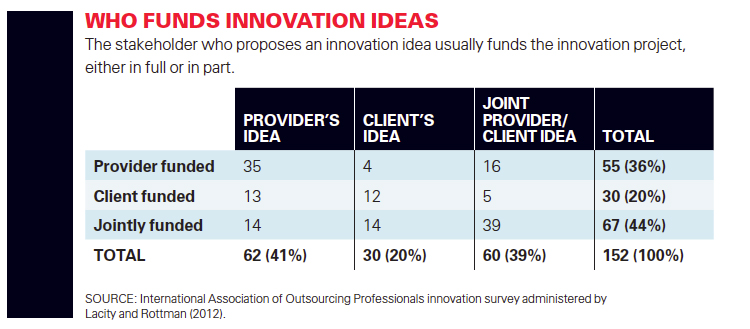
As we learned from the gain-sharing incentive, BPO innovations are most successful when they are funded as projects, each with a sound business case. But who foots the bill for process innovations? In our innovation survey, we found that 44% of the innovations were jointly funded, 36% were provider funded and 20% were funded by the client. Removing advisors from the data, we compared responses about funding to responses about the source of the idea. We found that stakeholders who propose innovations usually help fund their implementation. (See “Who Funds Innovation Ideas.”) This suggests that people tend to pitch innovation ideas that they themselves stand to benefit by and are therefore willing to finance the projects in whole or in part.
Clients from high-performing BPO relationships understand that they cannot be passive recipients of innovation. They must aggressively manage the change that innovation brings to their organizations. In other words, provider incentives lay the foundation for dynamic innovation, but the execution of dynamic innovation requires strong commitment to change management in order to transition individuals, teams and organizational units from the current state to the desired future state. Innovations must be accepted by two groups of clients — the client’s centralized business services organization responsible for the BPO relationship and the globally dispersed end users. Sometimes the client leaders resist innovation ideas because they lack the energy or resources to lead the change management effort required or because they have other priorities. One client told us, “For some of the provider’s ideas they’ve brought to us, we’ve said, ‘Thanks for telling us, but actually we’re not prepared to make the change.’” If the client leaders are excited about innovation and the leaders are respected within their own organizations, they are usually successful in their change management efforts. On the other hand, if the client often rejects ideas, the risk is that the provider will stop investing time and resources in identifying innovations. A provider in a high-performing BPO relationship says of his client lead: “He knows the business very well. He knows how relationships work, and he’s politically savvy.”
Having the Right Team
Many BPO relationships need to work on incentivizing, contracting for and delivering innovation. We found that the most significant factor in BPO innovation is whether the right people are in place to drive the dynamic innovation process. An effective leadership pair — one person from the client organization and another person from the provider organization — goes a long way toward invigorating the innovation process. Selecting the proper leaders is critical. In the high-performing BPO relationships we looked at, the leaders were experienced and capable and had high levels of credibility, clout and power within their own organizations. Effective leadership pairs enjoyed working together, which some research participants described as “chemistry.” They displayed the following behaviors:
A focus on the future: The leadership pair focused on where they wanted the BPO relationship to go, not where the relationship was or where it had been.
A focus on client outcomes: The leadership pair always did what was best for the client organization and then settled a commercially equitable agreement.
A spirit of togetherness: The leadership pair often disagreed behind closed doors, but they presented a united front to stakeholders in their respective organizations.
Transparency: The leadership pair was open and honest about all operational issues.
Orientation toward problem solving: The leadership pair sought to diagnose and fix problems; they did not seek to assign blame.
Orientation toward action: The leadership pair was not afraid to expend their powers; leaders acted swiftly to remove or work around obstructions to innovation stemming from people, processes or contracts.
Perhaps as a consequence of these behaviors, both leaders in these pairs displayed an optimal level of trust.11 Each felt secure and confident in the other person’s good will, intentions and competency.
In several cases, we found client-provider pairs in which both parties were experienced leaders but the combination simply did not work. Changing one of the leaders (or both, if necessary) can improve performance.12 For example, the client leader in one high-performing BPO relationship based in Europe told us that he had requested that the provider assign a different account manager when he could not work effectively with the original person; the provider granted the request. The client leader contrasted the two account managers: The first account manager “was a more senior guy with the attitude, ‘Well, I’ve done it, I’ve got the T-shirt, I know what I’m doing, I don’t know why you’re panicking, leave me alone to get on with it.’ He may have been a very good chap, but I couldn’t work with him.” The second account manager “was actually more junior but was somebody with whom we could work.”
BPO relationships that were performing poorly at first were transformed into good or even great BPO performers under new leadership pairs. The leaders were able to foster dynamic innovation by creating strong incentives. Even when contracts did not initially include innovation incentives, we found that several high-performance organizations added incentives after the BPO relationships stabilized. For example, one company required its BPO to demonstrate productivity gains year-on-year. However, the provider had no incentive to go beyond those levels. To maintain pressure, the client recently negotiated for a gain-sharing model in which the provider was rewarded for anything that went beyond the required percent of productivity. The client also stands to benefit. As the client explained, “We made it a joint-productivity gain initiative, so there is also reward and recognition for our own people when we go beyond the threshold.”
Effective innovators recognize that creating incentives can only take you so far. Delivering innovations requires participants to break habits, change their ways of doing things and mandate innovation. There’s a saying that if you always do what you always did, you will always get what you always got. Rather than being hemmed in by traditional modes of operation, companies and service providers have an opportunity to unlock value by working together to achieve dynamic innovations.


 Andy Wasser


 View Exhibit


